
Convert millimeter to fractional inches
Inches mm Table Generator
Table PDF inches & mm
Convert millimeter to fractional inches and inches to mm
just type a value, mm values just numbers and fractional inches values should include slash ( / ) or ( " )
How use this conversion calculator?
mm to in millimeter to fractional inches
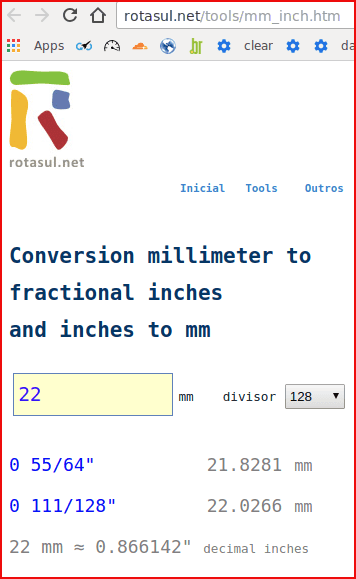
just enter the metric (mm) value and choose the divisor i.e.:
9.5 mm in divisor 16
0 5/16″ 7.9375 mm
0 3/8″ 9.5250 mm
in to mm decimal inch to fraction of inch and millimeter
enter the value using double prime (″), i.e.:
1.25″ dec. inch divisor 16
1 1/4″ 31.7500 mm
To improve the approximation in fractional inches, set 512 in the divisor.
in to mm fraction of inches to millimeter
enter value with slash (/), i.e.:
1/8 frac. inches divisor 64
1/8″ 3.1750 mm
enter value with space and slash (/), i.e.:
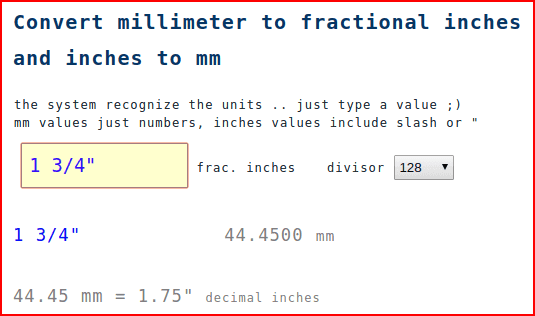
1 1/4 frac. inches divisor 16
1 3/4″ 44.4500 mm
or enter the value using ( " ), space or slash ( / ), i.e.:
1″ 3/8 frac. inches divisor 16
1 3/8″ 34.9250 mm
mistakes, typos or crazy values are rounded to the best approximation, i.e.:
2 3/83 frac. inches divisor 128
2 1/32″ 51.5938 mm
2 5/128″ 51.7922 mm
Limits
In practical workshop use, fractional inch measurements rarely exceed a denominator of 64. In such cases, the thousandth of an inch measurements "thousand" or "thou" (introduced by Whitworth, the same as the "threads") are more used and are equivalent to 1"/1000abbreviations:
thousandth > thou (UK)
mille > mil (USA)
even smaller:
tenths = thou / 10 = 0.0025 mm = 2.5 µm
The Metric System
The Metric System was officially created in France in 1790. Due to its advantages, it has been adopted by many countries. Currently, only a few countries do not use it, which facilitates scientific work and international trade.The Metric System uses 10 as its base, whereas the Imperial System uses 12, which is divisible by 2, 3, 4, and 6. In our daily lives, the use of such fractions (1/4 pound, 3/4 gallon...) is common, as is the use of some Imperial units such as the gallon in chemicals (1/4 gallon = 900 mL), gold in ounces, construction steel gauges, tire sizes (14″), many screws still marketed in inches, and even the screens of televisions and phones, which are still measured in inches.
Like other systems, the Imperial System had some slight variations between the standards adopted. For example, an inch in England was not exactly the same as a Canadian inch, and the Imperial gallon differed from the U.S. gallon. These and other differences generated numerous technical and commercial problems. It was not until the late 1950s that the Imperial System was standardized internationally, and among other resolutions, the equivalence between the millimeter and the inch was established: